
Most adults over 65 live with three or more chronic conditions at once. Family caregivers are the ones who keep the whole picture in view.
If you’ve ever left a doctor’s visit with more questions than answers—or felt like your aging parent’s care was a never-ending game of medical ping-pong—you’re not alone.
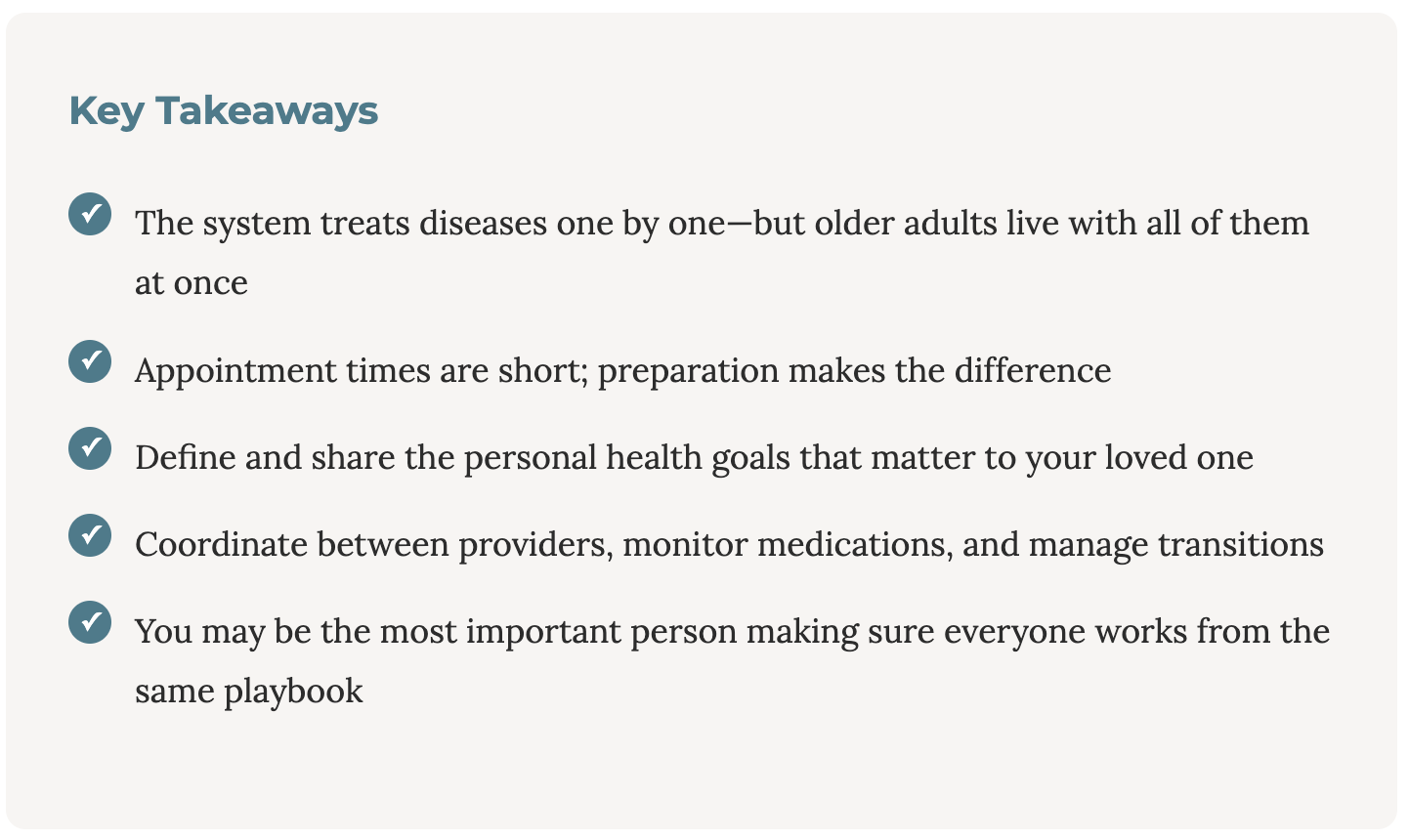
Our healthcare system is built to treat individual conditions—diabetes, heart disease, arthritis, depression—as if they exist in isolation. But most people over 65 live with several chronic conditions at once, and those conditions interact in complex, sometimes conflicting ways. As we learned in our Age Wise interview with Dr. Mary Tinetti, a geriatrician at Yale School of Medicine and a national leader in aging research, the gap is real.
“What’s good for the disease may not be good for the patient.”
— Dr. Mary Tinetti · Geriatrician, Yale School of Medicine
Said another way: bouncing from one specialist to another often misses the big picture. With ever-shorter appointment times, many older adults simply aren’t getting the coordinated care they need. That’s where family caregivers come in.
Why Caregivers Are Now the Quarterbacks
In an ideal world, a primary care doctor would coordinate everything. But as Dr. Tinetti put it, “We live far from an ideal world.” Most clinicians want to do the right thing—but they’re under pressure to see 20–25 patients a day, document in real time, and follow single-disease guidelines.
That creates a major gap, and caregivers fill it. You’re not just a companion at appointments. You’re the coordinator, translator, advocate, and decision guide—the one who helps ensure care reflects the whole person, not just their lab results. Here are six steps to make every visit count.
Step 1: Start With What Matters Most
These serve the same purpose—appointing someone to make medical decisions when the individual can’t—but terminology and scope vary by state. A healthcare proxy typically refers to the document itself and may be paired with a living will. A medical (or healthcare) POA is a broader term that can include added instructions, such as hospital transfers or specific treatments.
The medical system is built around the question “What’s the matter?” Dr. Tinetti’s work invites a better one: “What matters most to you?” Her initiative, Patient Priorities Care, helps older adults define personal goals—like walking without pain or having the energy to socialize—and use them to guide every decision.
- Ask: “What would a good day look like for you?”
- Write down 1–2 real-life goals (“I want to garden again this spring”)
- Make them SMART: Specific, Measurable, Actionable, Realistic, Time-bound
- Use myhealthpriorities.org for step-by-step guidance
Step 2: Maximize Short Visits
Some visits last just 15 minutes, and much of that time may go to a computer screen rather than your loved one. Make the minutes count by bringing a one-page summary:
- Diagnoses
- Medications (including over-the-counter and supplements)
- Allergies
- Recent hospitalizations or test results
- Their top 1–2 health goals, plus your key questions ranked by priority
As Dr. Tinetti reminds us: “It doesn’t happen in one visit. People aren’t used to thinking about what matters most. But when they do, it changes everything.”
Step 3: Be the Extra Set of Ears
Attend appointments whenever you can. Ask doctors to explain things in plain English, take notes (or record with permission), and confirm next steps—tests, referrals, medication changes. Afterward, summarize what happened in a shared health folder and update other family members or providers.
Step 4: Be Wary of Too Many Meds
Many older adults take multiple prescriptions—a situation called polypharmacy. Each may serve a purpose, but combinations can interact in harmful ways, especially when prescribed by different specialists.
- Use a pill organizer or digital reminder tool
- Ask for a full medication review at least once a year
- Watch for sudden changes in balance, appetite, or mood
- Ask “Is this still necessary?” for each prescription
As Dr. Tinetti said, “Trying to fix each little piece can make the whole system fall apart.” Treating everything can lead to overtreatment—and harm.
Step 5: Navigate Hospital Stays and Discharge
Hospital stays are stressful—but the bigger risk often comes after discharge, when follow-up care is unclear. To avoid complications, confirm with the discharge planner who’s responsible for follow-up, get clear written instructions (and review them verbally), ask whether new medications replace or add to the current list, and arrange home care or rehab support before discharge.
Step 6: When Memory or Cognition Affects Care
Cognitive decline—even temporary—can affect how your loved one manages medications, communicates symptoms, and follows instructions. Let providers know in advance, request extra time and written instructions, and confirm a healthcare proxy is in place and documented.
A System That’s Still Catching Up
Despite advances in geriatric care, much of the medical system still lags behind. Records remain siloed, research still focuses on one disease at a time, and insurance rewards volume over thoughtful conversation. But there’s hope—better care models and new tools are emerging. In the meantime, caregivers are the bridge, bringing humanity, clarity, and coordination to a system that needs it most.
🎙 Want to hear our full conversation with Dr. Tinetti? Listen to Episode 40 of the Age Wise Podcast →



Click or Call
Speak to a Specialist
You Don’t Have to Navigate This Alone
Coordinating care for an aging loved one is a role no one trains for—and it can feel like a second full-time job on top of everything else. Staying organized, keeping the home safe, and reducing the chaos around medical needs makes the whole journey more manageable.
At Silver Solutions, we’ve supported thousands of families through exactly these moments. We help create safer, more organized homes and offer ongoing virtual check-ins so small changes don’t become emergencies. We’re right here with you.
- Home safety assessments to reduce falls and hospital trips
- Decluttering and organizing for easier medication and document management
- Safety365 quarterly virtual check-ins as mobility and needs change
- Free, no-obligation consultations to build a plan that fits your family
Download the Full Age Wise Guide — Chapter 6
Get the complete Senior Health Care: Six Steps to Better Medical Visits chapter as a PDF—including the one-page visit summary, medication review tips, and discharge checklist.